Tellier Dynamics architected Radial Closed-Loop Geothermal Systems. By synthesizing the reservoir contact area of EGS with the environmental safety of conductive loops, the TRS architecture enables clean, continuous power without induced seismicity.
Existing closed-loop systems typically utilize parallel "U-loop" arrays. While effective in specific geologies, these parallel designs can suffer from increased thermal interference where the heat extraction of one lateral degrades the performance of its proximal neighbor.
The TRS Topology utilizes a central large-bore insulated injection hub feeding a distributed network of radially oriented production satellites. This diverging geometry maximizes the volume of rock accessed per meter of drilling, significantly delaying the thermal drawdown compared to packed parallel arrays. Downhole Isolation Nodes enable incremental scaling and capital deployment.
Diverging lateral geometry reduces thermal interference common in parallel stacked arrays.
Source: OpenGeoSys 3D FEA Simulation (SGP-TR-230)
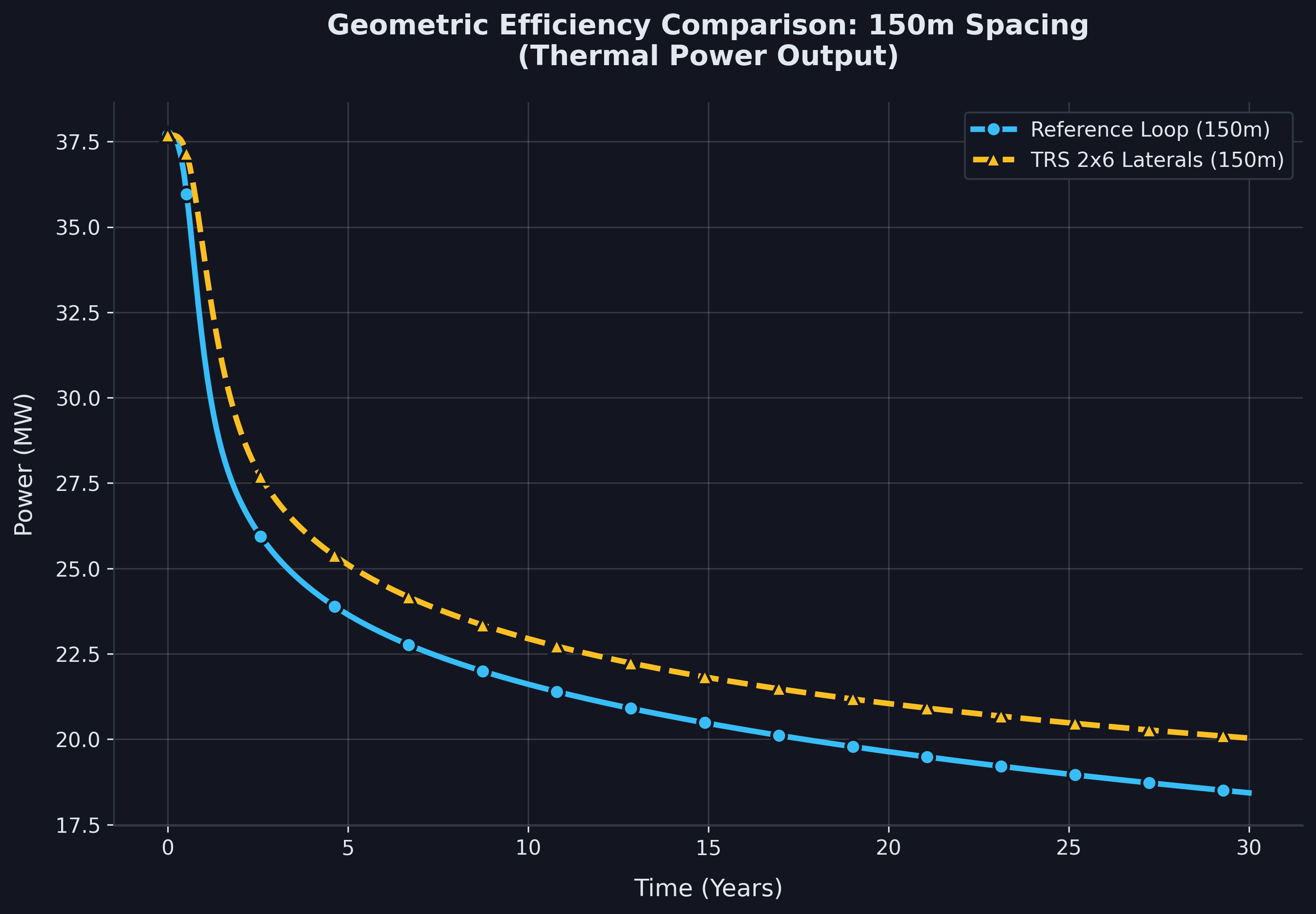
Comparative thermal drawdown analysis showing stabilized output temperature retention over the 30-year operational lifecycle.
Simulations normalized for drilling length demonstrate that radial fanning maintains outlet temperatures 2°C to 5°C higher than equivalent multi-lateral stacked designs.
The geometry prevents the formation of concentrated cold zones in the rock matrix, supporting a productive operational lifespan of >30 years with a shallower thermal decline curve than existing layouts.
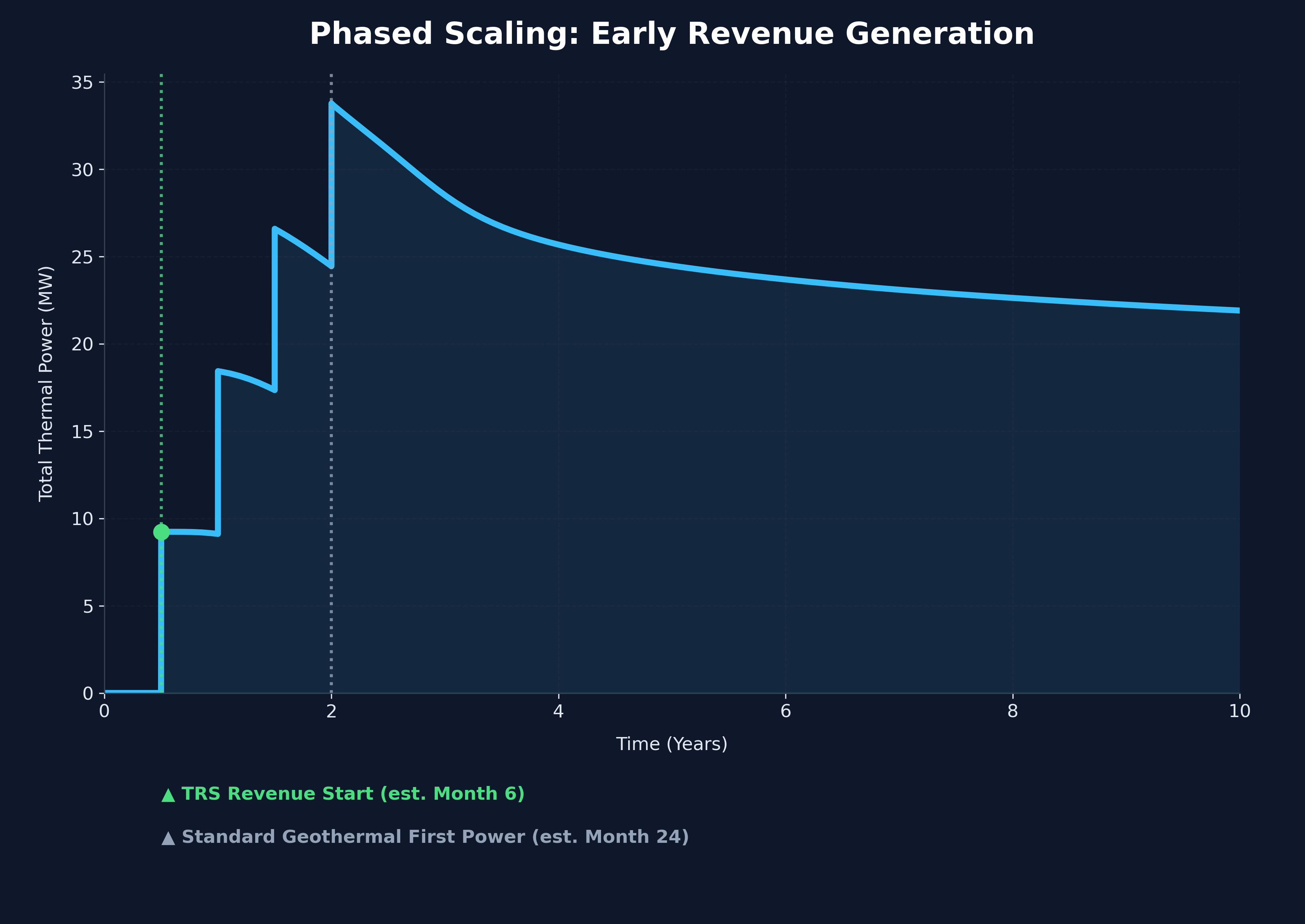
Traditional geothermal typically requires 100% of CAPEX deployment before the first kilowatt is sold. TRS changes the equation. By bringing independent satellites online sequentially, the architecture is designed to enable revenue generation as early as Month 6, funding subsequent expansion phases from operating income.
Projected early revenue start vs. industry standard T+2.0y construction delay.
Modeled reduction in initial capital at risk prior to reservoir validation.
*Projections based on TRS-V1 simulation data comparing phased radial deployment against standard parallel array construction baselines. Actual results may vary based on local geology and drilling conditions.
Figure 3.0: Modeled thermal power output. The TRS protocol is designed to secure cash flow 18 months earlier than the conventional closed-loop baseline.